Assessing Typer's Codebase Through the Lens of Simplicity: A Two-Part Analysis
When evaluating a codebase—we often rely on gut feelings or surface-level metrics like line counts. But what if we had a structured framework for assessing simplicity itself?

The Framework: 10 Laws of Simplicity
John Maeda’s laws translate to actionable software development principles:
REDUCE — Question what’s essential before adding
ORGANIZE — Group related functionality; clear boundaries
TIME — Optimize for development/build/runtime efficiency
LEARN — Clarity and documentation for future maintainers
DIFFERENCES — Balance simplicity with necessary complexity
CONTEXT — Fit changes within the broader system
EMOTION — Consider human experience of APIs
TRUST — Create reliable, predictable systems
FAILURE — Accept complexity; learn from false simplicity
THE ONE — Focus on what truly matters
For this analysis, we used this SKILL
Part 1: Initial Assessment
The Prompt Used:
“asses this current repo based on the simplicity principles - give an overall simplicity score from 10 points.”
My Approach: Quick exploration—README, directory structure, glob for Python files, line counts.
Initial Scores:
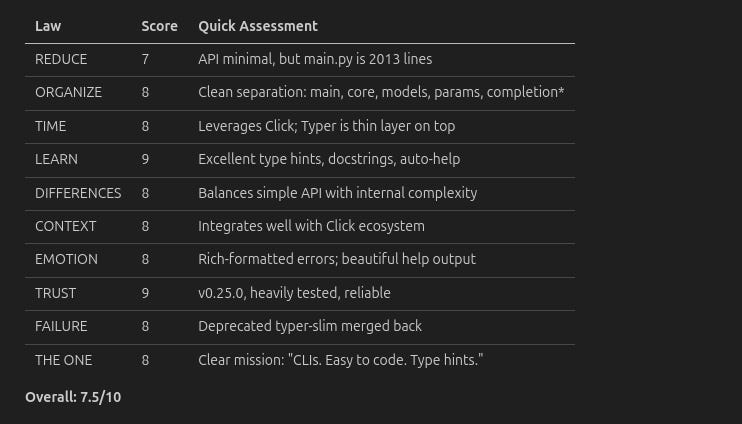
Part 2: Deep Source Code Analysis
The Prompt Used:
“could you please check more in-depth with full source code analysis again based on laws-of-simplicity”
My Approach: Full skill invocation—reading every module:
main.py(2,013 lines)params.py(1,831 lines)rich_utils.py(755 lines)core.py(820 lines)models.py(651 lines)And 9 others totaling 7,374 lines
The Paradox Revealed
This deep dive exposed a tension Maeda would recognize:
Typer’s simplicity for users is achieved through significant internal complexity.
Public API Simplicity: 9/10
Users write:
import typer

def main(name: str):
    print(f"Hello {name}")

if __name__ == "__main__":
    typer.run(main)
Two lines. Beautiful. Works.
Internal Code Simplicity: 5/10
params.pyhas two nearly identical function overloads (95% duplicate) — one forparser, one forclick_typemain.pyat 2,013 lines does too much: class definition + command building + exception handling + CLI invocationMultiple deprecated parameters marked “TODO: remove in future version” have been lingering since v0.16.0
A function copied from Click (
_split_opt) with only a comment noting the source
Detailed Scoring After Deep Dive
REDUCE — 6/10
From params.py — almost identical overloads:
@overload
def Option(
    parser: Callable[[str], Any] | None = None,  # Only difference
    ...
) -> Any: ...

@overload
def Option(
    click_type: click.ParamType | None = None,  # Only difference
    ...
) -> Any: ...
80+ parameters in Option(). Is this necessary complexity or false simplicity?
ORGANIZE — 7/10
Good modular structure, but:
rich_utils.py(755 lines) handles ONLY help text formattingmain.pyis monolithic
TIME — 7/10
Efficient at runtime, but:
Exception hook creates Rich tracebacks on every exception
inspect.signature()called repeatedly (expensive)
LEARN — 9/10
Internal functions lack docstrings:
# From core.py - no explanation of purpose
def _split_opt(opt: str) -> tuple[str, str]:
    first = opt[:1]
    ...
DIFFERENCES — 7/10
The Annotated Support is justified by complexity. But 80+ parameters?
CONTEXT — 8/10
Typer-as-CLI (typer main.py run) is clever. Rich is optional via TYPER_USE_RICH.
EMOTION — 9/10
User experience is delightful:
╭─ Error ───────────────────────────────────────────╮
│ Missing argument 'NAME'.                          │
╰───────────────────────────────────────────────────╯
But developer's experience of maintaining params.py is NOT delightful.
TRUST — 9/10
Mature, stable, backward compatible. FastAPI uses it.
FAILURE — 7/10
typer-slim merged back—learned that extra packages created friction. But deprecated code persists.
THE ONE — 7/10
Feature creep visible:
Rich help formatting (755 lines)
Shell completion (600+ lines across 4 files)
Auto-generated docs (
typer docs)Pretty exceptions
AI Reasoning: What the Model Observed
The Minimax M2.7 model made several interesting observations during analysis:
On the public/internal simplicity paradox:
“Typer makes CLI development simple for users by wrapping significant internal complexity. This is often necessary, but the codebase shows signs of accumulation without refactoring.”
On technical debt:
“Lots of
# TODO: remove in future versioncomments...shell_completedeprecated since 0.16.0, still present at 0.25.0”
On code organization:
“
rich_utils.py(755 lines) handles ONLY help text formatting - could be split”
On duplication:
“
params.pyhas massive duplication with two overloads that are ~95% identical”
Conclusion
Using Maeda’s Laws of Simplicity as an analytical framework revealed nuances that traditional code review misses:
What users experience vs what maintainers experience
Justified complexity vs accumulated complexity
Surface simplicity vs structural simplicity
Typer excels at the first dimension—users get a delightful experience with minimal code. But the internal codebase carries weight that any contributor would feel.
The Laws of Simplicity didn’t tell me how to fix these issues. That’s not its purpose. Instead, it provided a structured vocabulary for articulating what I was sensing: a gap between the library’s elegant public face and its complex internal reality.
Final Score: 7/10 — A strong library whose internal simplicity work is ongoing.
Appendix: Prompts and AI Reasoning
Prompts Used
Initial assessment:
asses this current repo based on the simplicity principles - give an overall simplicity score from 10 points.Deep analysis:
could you please check more in-depth with full source code analysis again based on laws-of-simplicity
Skill invocation:
skill laws-of-simplicityAI Model Reasoning Process
Minimax M2.7 was used for this analysis. Here’s what the model observed:
The model invoked the laws-of-simplicity skill before diving deep, ensuring the framework was properly loaded and applied systematically.
The model read ALL source files, not just top-level modules:
14 Python modules analyzed
7,374 total lines of code reviewed
From
__init__.py(39 lines) tomain.py(2,013 lines)
The model identified specific code patterns that violated simplicity principles:
Duplicate function overloads in
params.pyMonolithic files that do too much
Deprecated code is still present
The model recognized the paradox — public API simplicity vs internal complexity — and articulated it clearly rather than just scoring high because users have a good experience.
The model maintained the framework’s discipline — it didn’t jump to recommendations (”how to fix”) but first articulated the observations (”what is”).
Related Articles:
The Laws of Simplicity by John Maeda (Book)